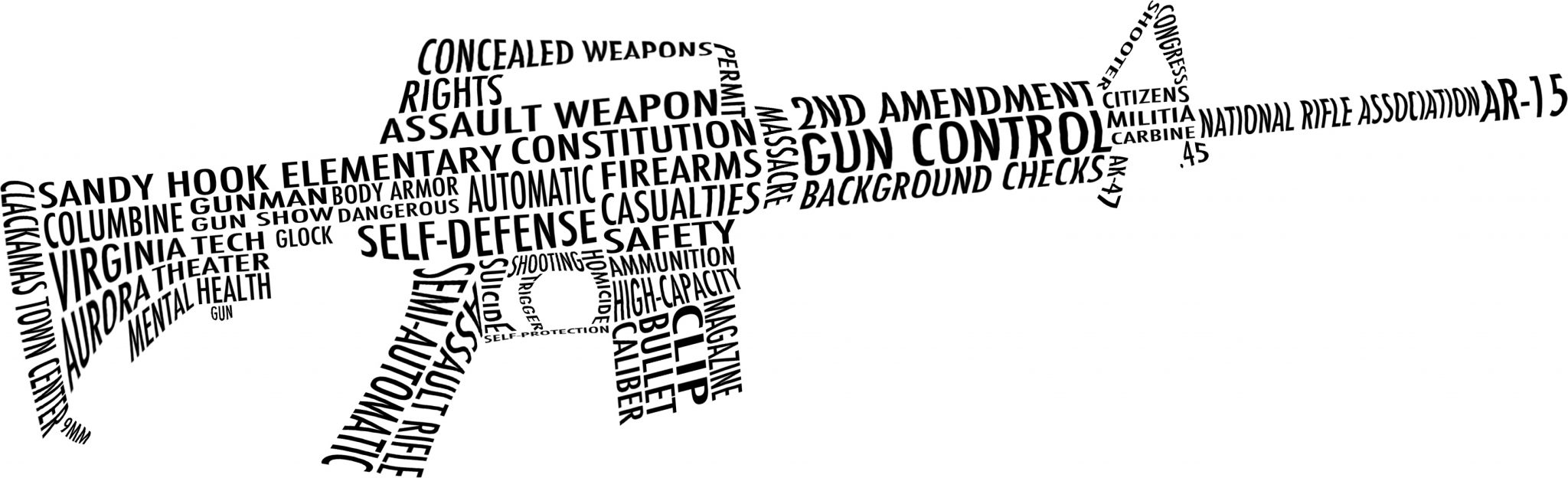
(Image credit: The Advocate)
This post is a response to/commentary on an article written by Ryan Fedasiuk at his blog, Fedasiuk Thoughts. If you haven't read it yet (and I strongly encourage you to read it), you can find it here: http://fedasiukthoughts.blogspot.com/2015/12/take-away-all-guns-radical-idea-and.html
Yesterday, American University student and Congressional Debate wunderkind Ryan Fedasiuk published a thought-provoking piece on his blog suggesting a radical idea with regards to American gun control: that to protect Americans from gun violence, either against one another or against themselves, firearms need to be totally removed from American society (the how, as an ethically, legally, and practically ambiguous issue, is reasonably left as an open question). His central point, essentially, is that any policy short of those bans will fail to materialize in lower rates of gun homicide and suicide.
However, to really understand whether this point is correct, we need to examine a few truths, all of which are partially removed from the larger debate surrounding gun violence in the United States:
1. Research is inadequate.
Few reliable studies exist to date that empirically measure the effectiveness of gun control policies. As such, pundits and policymakers are often left with mere speculation as to the usefulness of these policies and their implications. Part of the reason, of course, is political. In 1996, the National Rifle Association lobbied legislation into Congress that banned the Centers for Disease Control from conducting research on gun violence as a matter of public health. Citing the fear that the CDC would be used as a political wing of the left to force anti-gun measures onto the public, the NRA successfully pushed for the law's passage, and thus stymied the flow of dollars and political will towards using the scientific method to guide policymaking on this urgent life-or-death issue.
Since 1996, the debate on gun control legislation has been repetitive and inconclusive. Advocates wave their arms and point towards tragedies as the pretext for passage, while skeptics make logical leaps about the feasibility of black markets and the willingness of criminals to get their hands on firearms. What little evidence exists is usually just a handful of correlational studies (none of which prove causation, and many of which fail to control for confounding variables), alongside the logical (but not necessarily correct) speculation of endless experts and academics.
Fedasiuk may be right that the current measures we have offered up as solutions to gun violence are ineffective. But we have no idea whether that's actually the case, nor have we even begun to scratch the surface of the potential policies we might have at our disposal once new research comes to light. When it comes to complex problems, innovation is key, and before we can discover innovative policy, and before we can implement it effectively, we need an empirical leg to stand on.
2. Different approaches yield different results.
Speaking of innovative policymaking: in 1994, Connecticut implemented a bold new gun-control measure called permit-to-purchase. The premise of the law was simple and elegant: in order to buy a gun in the state of Connecticut, you need to obtain a permit from the state, which mandates a background check and a gun safety course. At the time of its passage, critics made more or less the same charges that critics of gun control policies always have made and always will make: that criminals will merely turn to the black market following new restrictions.
However, recent research seems to assuage those concerns. By examining records on gun killings collected by the CDC, researchers at John's Hopkins and UC Berkeley compared Connecticut's gun crime statistics with those of similar states, and found that even as gun homicides began to fall for all states over the course of the 1990s and early 2000s, Connecticut's number of gun homicides fell farther and faster than other states, even when controlling for confounding variables like income and policing. Beyond that, the researchers compiled data from statistically-similar states into a "synthetic" version of Connecticut, essentially mapping out what the state's gun homicide rate might have looked like if the law were never passed, and found a 40% decrease in gun homicide between the real Connecticut and the synthetic non-permit-to-purchase Connecticut.
Further, they found no significant difference between the real and synthetic Connecticut in terms of non-gun homicides. Hence, the implications are two-fold: restrictions on gun purchases did not result in an increase in non-gun killings, and the underlying factors that would result in a change in either kind of homicide are ruled out in the process.
Of course, one study alone cannot by any measure prove conclusively that permit-to-purchase is a wholly effective measure, even less a measure that works in other states. But Connecticut's example warrants further examination, and if we go off the current evidence, policies like permit-to-purchase may be an effective alternative to the kinds of total bans that Fedasiuk advocates for.
3. Gun violence is a symptom of deeper problems, which gun control policies fail to address.
Further, in recognizing the fact that Connecticut is in no way identical to all other states in the US, we need to consider some of the ways in which that's true. Connecticut, for example, is among the states in the US with the lowest overall poverty rate. It is also among the states with the best public school systems. The opposite, however, is often the case for states that experience the most gun homicide.
Academics and scientists have debated (and will continue to debate) for decades about what the individual and social roots of crime are in the United States. But it would be foolish to suggest that poverty, family strife, failing K-12 education, the war on drugs, and undertrained and underfunded (if not absent) police departments (often with hostile community relations) aren't part of the problem. The means by which gun crimes and gun homicides are committed are certainly important, but a policy that merely addresses the means without addressing the causes will be stunted in its effectiveness.
It begs a larger question which tends to go unanswered in liberal circles: while gun control policy can be used to address these problems, why should it be used, and does it really need to be used in that capacity? One could reasonably argue that it doesn't. After all, if gun violence is a symptom of deeper social and individual ills, then policies that address those ills could render sweeping gun legislation unnecessary, compared to the smaller and non-restrictive policies that Americans seem to support.
Of course, no simple solution exists for this myriad of problems, and each area has its own center of debate. Similarly, the existence of gun crime and gun violence exacerbates all of the problems aforementioned, which makes gun control measures all the more necessary when adequately supported by research. But when the political will focuses only on gun control when discussing gun violence, they sidestep those difficult problems, and leave stark inequities without redress. The same goes for issues of suicide and mental health, the support systems for which are woefully inadequate in our culture and our institutions today.
If liberals used gun violence as a pretext for criminal justice reform and antipoverty action, and used gun suicide as a pretext for mental health reform, rather than focusing myopically on the hot-button issue of gun control, then they might create bipartisan support for real reforms that help reverse the deep-seated problems that lead to gun violence in America. And in doing so, they make non-restrictive gun-control measures, like Connecticut's permit-to-purchase law, all the more effective.
4. Regardless of the potential benefits, a sweeping ban on firearms is (and may always be) politically unfeasible.
While examining potential policies in a vacuum is typical and acceptable, claims that a policy will have an effect on the real world need to account for the political context in which they would be implemented. As we live in a representative democracy, sweeping bans on firearms cannot be realistically or ethically achieved until the vast majority of Americans come to accept them.
This is doubly true when considering the Constitutional implications: if sweeping gun bans are passed, and then subsequently struck down by the Supreme Court due to 2nd Amendment objections, then it could take a Constitutional amendment to bring a sweeping gun ban back into play. Passing such an amendment requires a 2/3rds vote of both houses of Congress, and then passage by 3/4ths of the nation's state legislatures, a feat which requires a massive amount of bipartisan support.
That kind of support doesn't exist in the United States today and, barring the typical arguments on gun control, that lack of support is the main source of ethical dilemmas when discussing the how of a sweeping gun ban.
State governments in areas where pro-gun support is high would almost certainly refuse to comply. Should the federal government force them to implement the policy, against the wishes of their citizens? The implications of forcing a state to take such action is hardly as morally cut-and-dry as other cases in recent memory, like those pertaining to civil rights. Other methods of coercion exist, like threatening to cut federal funding, but starving public institutions of the funds they use to meet the needs of their constituents is difficult to justify, again, because of the ambiguities of the gun control debate.
With regards to individuals, how do we plan to enforce prohibition? Do we confiscate firearms by force and implement penalties? Doing so would certainly reduce the number of guns on the streets, but would present the same kinds of issues faced during the war on drugs, not the least a criminal justice system flooded with newly-minted offenders, many of which were convicted of a victimless crime. Further, due to the sheer volume of guns that exist in the United States today, one could hardly expect effective collection without significant surveillance and resultant violations of our rights to privacy.
How about a buyback program? While it might certainly collect some of America's many firearms, it still leaves the question of what we'd do with the rest of those who don't enter the buyback program, and further leaves the logistical concerns of what we do with the guns after we've collected them.
One of the only speculative policies that sidesteps these concerns, in part, is a ban on the manufacturing of ammunition. While guns are built to last (with proper maintenance) and can change multiple hands, ammunition is a finite resource. Makeshift and smuggled ammunition is bound to appear, but doubtlessly in far smaller amounts than ammunition produced by large industrial manufacturers.
Still, a ban on ammunition will be a hard sell to a nation so politically polarized, especially with a right wing that's leaning farther and farther rightward as the years go by. Even bans on ammunition are bound to face their own 2nd Amendment challenges, and without overwhelming public support, there's reason to doubt that the policy will be successful.
Towards a Better Future
All things aforementioned in mind, a new synthesis of policy is necessary:
First, end the ban on gun violence research. The age of policymakers grasping at the dark for solutions must come to an end if we want to see an end to the violence.
Second, use the states as a proving ground for new, research-based policies. Some states are more likely to accept gun control regulation than others, and as the example of Connecticut demonstrates, those states may reap generous benefits in the process. Similarly, by using the states as policy laboratories, policymakers can see which types of gun control work where.
Third, divert some of the political will away from gun control and devote it to finding and implementing solutions for the problems that make gun crime occur in the first place.
These three steps may be the first of many in a long and sordid journey, but they're steps that are necessary to take if we want to see a decline in gun homicides in the United States. If that eventually leads to a total ban of firearms as Fedasiuk supports, given the will of public opinion, then so be it. But until then, it's best to organize around specific and realistic policy goals, ones that generate specific and realistic solutions.
Read Ryan Fedasiuk's original article here: http://fedasiukthoughts.blogspot.com/2015/12/take-away-all-guns-radical-idea-and.html

No comments:
Post a Comment